
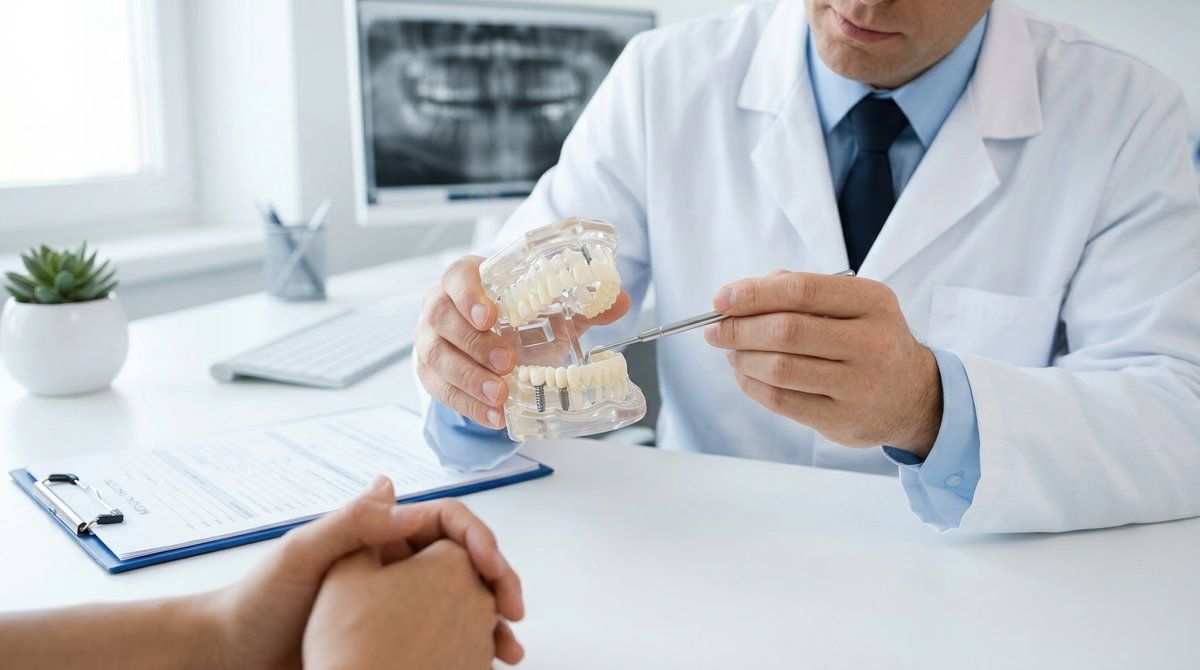
Missing even one tooth can throw off far more than your smile. It changes the way you chew, puts extra strain on neighboring teeth, and can gradually shift your bite out of alignment. Left alone, a gap can lead to more problems, such as nearby teeth drifting out of position, which can make a small issue harder to fix later.
At All Smiles Dentistry, we aim to deal with this kind of problem before it grows. A dental bridge is one way we close the space left by one or more missing teeth as part of our restorative dentistry, for patients throughout Lake Stevens. Your dentist will help you decide whether a bridge is the right fit for your gap.
A dental bridge replaces missing teeth by anchoring a false tooth, called a pontic, to the natural teeth or implants on either side of the gap. Those supporting teeth are known as abutments. Think of a footbridge: it only works if the footings at both ends are sturdy. Once your bridge is in place, it can help you chew and speak more comfortably, although it will not work exactly like a natural tooth.
A gap can feel like the biggest concern, but the effects on chewing often matter more over time. According to the Centers for Disease Control and Prevention, tooth loss can lead to poor diet, low self-esteem, difficulty speaking, and overall lowered quality of life. Neighboring teeth can also drift into an open space over time, which can change your bite. A well-fitted bridge fills that space, helps keep nearby teeth in place, and spreads chewing forces more evenly. If you are comparing a bridge with a single crown, see our crowns and bridges page.
Not every patient needs the same solution, so we look at your bite, the condition of nearby teeth, and your long-term goals before recommending a type of bridge.
Traditional bridges use a pontic fused between two crowns placed over the abutment teeth, and they are one of the most common options.
Cantilever bridges anchor to a single abutment tooth, which can work when only one healthy tooth sits next to the gap.
Implant-supported bridges rely on dental implants instead of natural teeth for support, which is often considered when several teeth in a row are missing.
When several teeth are missing in the same area, we often talk through implant-supported options alongside our dental implants, because implants can give a bridge added stability, depending on the bone available. A fourth type, the Maryland bonded bridge, is covered in the table below.
Not every gap calls for the same bridge. This quick comparison shows how the four types differ, and your dentist will recommend one after examining your bite.
| Bridge type | What holds it in place | Often considered when | Worth knowing |
|---|---|---|---|
| Traditional | Crowns on the teeth on both sides of the gap | Healthy teeth sit on both sides of the gap | Those two teeth are shaped to hold crowns, so they need to be strong enough to carry the load |
| Cantilever | A crown on one tooth next to the gap | Only one healthy tooth sits next to the gap | One tooth carries the whole load, so your dentist looks closely at your bite |
| Maryland bonded | Small wings bonded to the backs of the neighboring teeth | The neighboring teeth are healthy and should be altered as little as possible | Often considered for certain front-tooth gaps, depending on how your bite closes |
| Implant-supported | Dental implants placed in the jawbone | Several teeth in a row are missing, or you would rather not alter the neighboring teeth | Takes longer because implants need time to heal. Imaging checks your bone, and bone grafting may be recommended if bone is thin |
Comparing a bridge with a single crown? See our crowns and bridges page.
A bridge works best when the teeth and gums around the gap are in good shape. Here is how common situations are usually handled.
Your exam and imaging show which situation fits you best.
Getting a traditional bridge typically takes two visits, and some cases need a third. At the first appointment, we prepare the abutment teeth by removing a small amount of enamel to make room for the crowns, then take precise impressions or digital scans used to craft your custom bridge. A temporary bridge protects the area while your permanent restoration is made. At the second visit, we check the fit and bite of your new bridge before cementing it into place. Some patients notice sensitivity for a few days, and your dentist will tell you what to expect in your case.
Here is the general path for a traditional bridge. Your dentist will confirm the steps and timing for your situation.
Implant-supported bridges involve extra steps and healing time, and your dentist will walk you through them.

With good care, a bridge can last many years, and how long depends on your daily cleaning, your bite, and the health of the supporting teeth. Brushing and flossing around the abutment teeth stay essential, and a floss threader or water flosser can clean beneath the pontic where regular floss cannot reach. Routine dental exams let us catch early signs of decay or gum recession around the abutment teeth before they affect the bridge, and our oral hygiene guidance can help you build a daily routine. If you grind your teeth at night, a custom night guard may help protect the bridge and the teeth around it.
Sometimes extensive damage or several missing teeth call for a broader approach than a single bridge. If you are missing teeth in several areas or have a more complex bite, we may talk with you about full mouth reconstruction instead, which addresses several concerns in one coordinated plan.
If a tooth near the gap is too damaged to serve as a strong abutment, we may recommend extraction before moving forward with a replacement option, so the foundation for your bridge is as strong as possible.
Both can replace a missing tooth. This quick look shows how they differ, and your dentist can help you decide.
| What to consider | Dental bridge | Dental implant |
|---|---|---|
| Neighboring teeth | Used as supports, so they may need shaping | Stand on their own, so neighbors are not used as supports |
| The tooth root | Not replaced | Replaced by an implant in the jawbone, which imaging checks for enough bone |
| Typical timeline | Often two visits for a traditional bridge | Several months in many cases, because the implant needs time to heal |
| Daily care | Clean beneath the false tooth with a floss threader or water flosser | Brush and floss as usual, with extra attention around the implant |
Neither option is best for everyone. Learn more about dental implants.
We want you to know where you stand before treatment begins.
At All Smiles Dentistry, we offer general and restorative dentistry under one roof, so your bridge fits into a broader plan for your oral health instead of standing alone. Our team includes Dr. Izoh Ashour, a board certified periodontist and implantologist, so gum health and implant options can be part of the same plan. Meet our team.
Comfort matters to us. If dental work makes you anxious, ask about nitrous oxide, and our team will walk you through each step before we begin.
Cost is a real concern with restorative work, so we want you to know where you stand early. We are contracted with Delta Dental, Regents, and Primera, and we can help you look into what your other plan may cover. For the rest, financing is available through Cherry and CareCredit. See our insurance and dental financing pages for details.
If a gap has been affecting your bite or your day-to-day comfort, we would like to help. To talk through which type of bridge, if any, fits your situation, schedule a consultation.
A Maryland bonded bridge replaces a missing tooth with a false tooth held by small wings bonded to the backs of the neighboring teeth, so those teeth usually need little shaping. It is often considered for certain front-tooth gaps when the neighboring teeth are healthy and the bite is gentle on that area. Whether it fits depends on your bite and the condition of your teeth, and your dentist can tell you at your exam.
Sometimes. A bridge needs strong supports, so we check the neighboring teeth first. A tooth with decay may need a filling or root canal treatment, gum disease may need treatment, and a tooth that is too damaged may need extraction. In some cases an implant-supported bridge avoids using the neighboring teeth at all.
A temporary bridge protects the prepared teeth and the gap. Your dentist will give you care instructions, which often include being gentle with sticky or hard foods and cleaning carefully around it. If it comes loose or breaks, call us so it can be re-secured.
Brush twice a day and use a floss threader or water flosser to clean beneath the false tooth, where regular floss cannot reach. Regular dental exams help us catch problems early, and our oral hygiene guidance can help with your routine. If you grind your teeth at night, ask about a night guard.
Coverage depends on your plan. We are contracted with Delta Dental, Regents, and Primera, and we can help you look into what your other plan may cover. If part of the cost is yours, financing through Cherry and CareCredit can spread it out. See our insurance and dental financing pages.
Waiting does not always cause problems right away, but a gap can change how you chew. The CDC notes that tooth loss can lead to poor diet, low self-esteem, difficulty speaking, and overall lowered quality of life. Neighboring teeth can also drift into the space over time, which can shift your bite and make later treatment more involved. An exam can show what is happening in your mouth and what your options are.
Our team always listens to your concerns and gets to know you before customizing your experience to your needs. We want to ensure your comfort while bringing you the best treatments modern family dentistry has to offer.
Feel relaxed at your Lake Stevens dentist as our team takes great care of you. If you’re feeling nervous, our nitrous oxide or conscious sedation options can put you at ease. We’re in good hands here. Feel relaxed at your Lake Stevens dentist
Each time you visit, expect the same level of high-quality care with modern technology and your own dedicated provider. Discover more effective and gentle dentistry with digital imaging, lasers, same-day crowns, and more.

Dr. Jason Steinhubel opened All Smiles Dentistry in Lake Stevens in 2004 to give the community he loves a better dental experience. A member of the American Dental Association, he brings a background in forensics, dental assisting, and dental lab work to a technology-forward, family-focused practice built on prevention, education, and comprehensive care under one roof.
View Dr. Steinhubel's full profile